

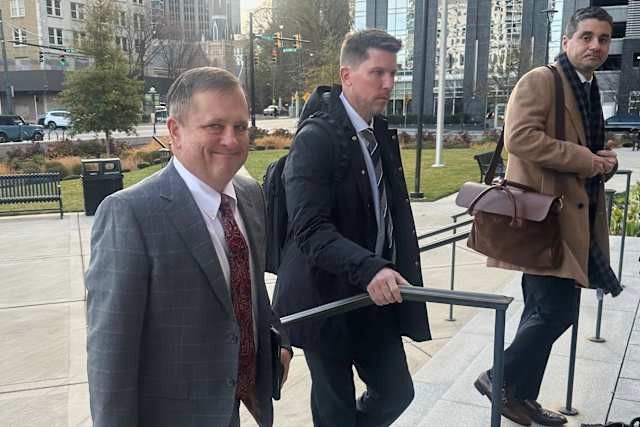
The third day of testimony in the NASCAR antitrust trial delivered the same tense exchanges that the first two days did, beginning with NASCAR executive vice president Scott Prime and ending with Front Row Motorsports owner Bob Jenkins.
Together, their testimony painted sharply different pictures of how the sport’s business model works, where teams believe it is failing, and how much leverage NASCAR holds in the charter system.
Prime returned to the stand in the morning, answering a barrage of questions from 23XI Racing attorney Jeffrey Kessler about the core structure of the charter agreements.
Kessler leaned heavily on the teams’ warnings from early in the negotiation process—that the business model was still unsustainable—and pressed Prime to acknowledge that teams have no realistic alternative outside of NASCAR.
Prime refused to concede the point, responding repeatedly that NASCAR is “the leading stock car series.”
A central dispute involved the charter’s “goodwill protection” clause, which restricts teams from racing in other stock-car series and includes a 12-month waiting period if a team gives up its charter and chooses to race elsewhere.
Secure your spot today.
Kessler called it a non-compete. Prime allowed only that it was a “narrow” one, adding that NASCAR saw the restrictions as necessary to protect the sport’s intellectual property and prevent copycat series built around Next Gen technology.
He also confirmed teams were aware of and supported the Gen-7 IP protections.
At several points, Kessler attempted to get Prime to label the exclusivity provisions as a “monopoly.”
Prime declined.
He also acknowledged NASCAR’s revenues for 2025 were either flat or trending slightly downward.
Kessler challenged Prime’s testimony surrounding the 2016 charter negotiations, pushing him on documents that contradicted his statements that teams were satisfied with the original financial structure.
Prime admitted he couldn’t personally confirm how teams felt at the time because he joined NASCAR in November 2015.
Kessler asked the judge to instruct the jury to give that testimony less weight; Judge Bell declined, remarking, “You’ve made your point.”
The questioning intensified when Kessler returned to Prime’s earlier text messages referring to “zero wins” for the teams during negotiations and disagreements among top executives—including Prime, O’Donnell and Phelps—over the direction of talks.
Kessler also revisited the internal “gun to the head” comment Prime used to describe Jim France’s stance as the Sept. 6, 2024 “take it or leave it” deadline approached.
Prime repeatedly insisted it was simply a deadline needed to prepare for 2025, even as Kessler pressed him on what would actually happen to teams refusing to sign.
Though Prime said NASCAR never threatened to revoke charters, he stopped short of saying what the expiration of a charter agreement would mean in practical terms.
Kessler also argued that Prime’s list of possible venues for a breakaway series—several of which were street courses—was unrealistic, pointing out NASCAR’s reported $50 million loss over three years in Chicago.
Prime countered that the earlier conversations about tracks were largely about scheduling consistency for broadcast partners and not exclusivity demands by the tracks themselves.
Prime’s testimony ended mid-afternoon, and the focus shifted to Bob Jenkins, whose quiet delivery contrasted sharply with the intensity of the morning.
Jenkins disclosed that Front Row Motorsports loses approximately $6.8 million annually and has never turned a profit under the charter system. He also said he has never taken a salary from the team.
This season alone, nine races went unsponsored, forcing him to run his own companies on the car to avoid blank entries.
Jenkins said that before the Next Gen car, FRM spent about $1.8 million per year on parts; that figure has grown to nearly $4.7 million annually under the spec-car system.
Even a clean race costs $30,000 per week for required vendor-supplied nose and tail pieces the team is not allowed to repair on its own.
Jenkins argued it is offensive for NASCAR to suggest teams overspend, saying the economics have worsened since charters were introduced.
Jenkins testified that none of the team owners he spoke with were happy about signing the 2025 charter proposal and that the deal “went so far backward” he declined to sign for multiple reasons.
“This is not about bashing the France family,” he said, noting their contributions to the sport. “But this charter agreement is not one of them.”
Tempers briefly flared when both sides violated pre-trial limits on questioning, prompting Judge Bell to issue a stern warning that further violations would bring significant consequences.
Under cross-examination, NASCAR pressed Jenkins on sponsorship arrangements involving his other businesses and his family’s companies.
NASCAR questioned why FRM would seek damages from the league when, in some cases, drivers or sponsors were allowed to donate to schools Jenkins founded instead of paying the race team directly.
Jenkins maintained those arrangements were made in good faith and noted that one such deal—Matt Tifft’s—was never completed because Tifft’s medical issues ended his driving career early.
NASCAR also argued that if the team claims financial harm, it was contradictory for Jenkins not to bill his sons’ Long John Silver’s franchises when they appeared on the car.
Jenkins responded that those appearances only occurred when real sponsorship could not be found.
Additional financial context emerged: Chandler Smith paid $1.5 million for a Truck Series ride last year, Ford contributed $1.175 million to the team in 2025, and FRM is seeking $140 million in damages related to what the teams describe as their underpayment between 2021 and 2024.
At one point, Jenkins reflected proudly on his background as a Tennessee native and lifelong Dale Earnhardt fan.
When describing how some might call him a “redneck,” observers noted the remark appeared pointed given previous internal NASCAR messages that used the term in a demeaning context.
By the end of the day, the jury had heard two contrasting narratives. One from an executive defending NASCAR’s need for control and structure, the other from an owner who said the economics have collapsed around him despite his loyalty to the sport.
The trial continues Thursday with more witnesses and more scrutiny of how NASCAR’s business model operates behind the scenes.
















Discussion about this post